

You’ve been onboarded, you’ve booked your first shift, and now you’re staring at an instruction email that says “report to Gate K, 11:00, black trousers”. Here’s what the day actually looks like, so nothing surprises you.
Before the day
Your operator will send shift details 2–7 days ahead, usually through a staffing app or portal. Check three things immediately:
- The exact report location. Staff entrances are almost never the main fan entrances. “Gate K” or “the staff check-in marquee” can be a 15-minute walk around the outside of a large ground – arrive at the wrong side of Wembley and you’ll be late even though you’re at the stadium.
- The dress code. Standard for catering is black trousers, black shoes (comfortable and closed-toe – you’ll stand for 8+ hours), and either your own plain black top or a uniform shirt they hand you on arrival. Stewarding operators usually provide a jacket or tabard; you provide dark trousers and boots.
- What ID to bring. Most operators want photo ID on the first shift even after onboarding. Bring it every time until told otherwise.
Eat before you leave. Your first meaningful break may be 4–5 hours after sign-in.
Hour by hour: a 15:00 Saturday kick-off, catering shift
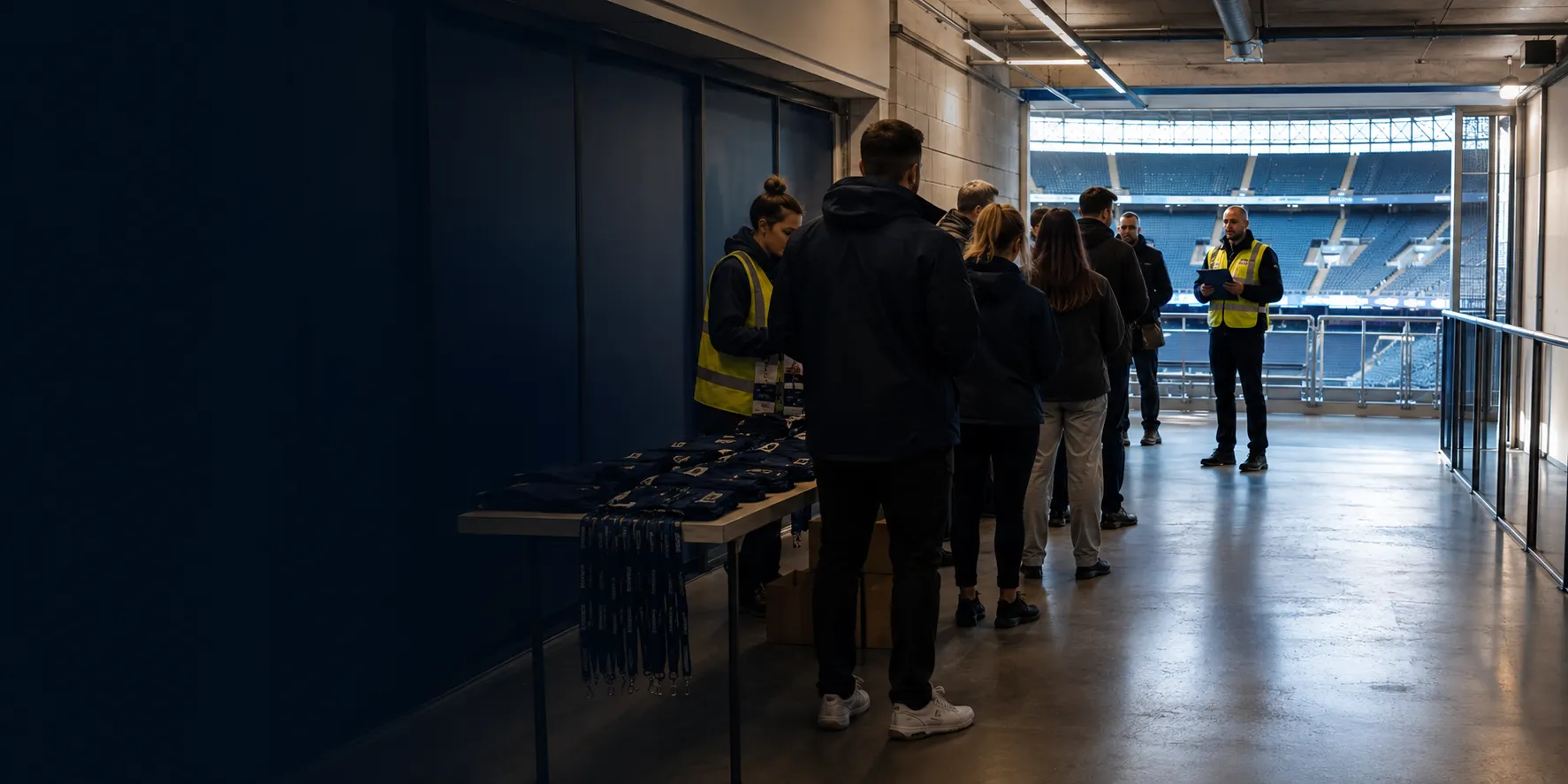
- 11:00 – Sign in. Queue at the staff entrance, sign in (usually a QR code or a clipboard), collect your uniform item and any allergen/till briefing sheets. Security will search your bag – leave anything you don’t need at home.
- 11:30 – Team briefing. Your supervisor assigns you to a unit: a kiosk, a bar, a lounge. First-timers are usually paired with someone experienced. The briefing covers the event, expected crowd, till prices, and anything unusual (cup fixture, segregation changes, cashless reminders).
- 12:00–14:00 – Setup. Stocking fridges, setting up tills, prepping food, counting floats. This is the calm part of the day – use it to learn where everything is, because you won’t have time to ask later.
- 14:00–15:00 – First rush. Gates open roughly two hours before kick-off. The 45 minutes before kick-off is one of the two big serving windows.
- 15:00–15:45 – First half. Quieter. Restock, clean, rotate short breaks.
- 15:45–16:05 – Half-time. The most intense 20 minutes of the day. A busy kiosk can take more transactions at half-time than in the rest of the day combined. Keep serving; it ends as fast as it starts.
- 16:05–17:00 – Second half. Wind-down begins. Some units close; staff consolidate.
- 17:00–19:30 – Close-down. Cashing up, cleaning, waste, restocking for the next event. Less glamorous, still paid.
- 19:30–20:00 – Sign out. You must sign out or you may not be paid correctly. Hand back uniform items if required.
Stewarding runs a similar shape but starts with a security briefing and position allocation, and the pressure peaks at ingress (gates opening) and egress (full-time) rather than half-time.
Breaks, food and phones
- Expect one main break of 20–30 minutes on a standard shift, scheduled around the quiet phases – not at half-time.
- Most catering operators provide a free staff meal on shifts over ~6 hours, served in a staff canteen area.
- Phones stay in pockets or lockers while you’re on position. It’s the fastest way to get a first shift marked as a bad one.
The unwritten rules that decide whether you get more shifts
Operators grade casuals informally from day one. The things that actually matter:
- Turn up, on time, every time you book. No-shows and late cancellations are the number-one reason casuals stop being offered shifts. Reliability beats experience.
- Ask your supervisor when unsure – about a till, an allergen, an aggressive customer. Nobody expects a first-timer to know things; they expect them to ask.
- Say yes to close-down tasks. The people who vanish at full-time get remembered for the wrong reasons.
- Introduce yourself to the supervisor at the end. “First shift, really enjoyed it, I’m available for the next home game” is genuinely how people end up on the priority list.
Getting home
Evening fixtures and concerts finish for staff at 23:00–00:00. Before you book a late shift, check the last train, tram or bus from the stadium – some grounds (Wembley, Tottenham) have good late transport, others empty out fast. If you drive, staff parking usually needs booking in advance. This is worth solving before shift one, not at 23:30 on the night.
Getting paid
You’re paid for the hours between sign-in and sign-out, usually weekly or fortnightly and always in arrears – so expect the first payment 1–2 weeks after the shift, not the next day. If the first payslip looks wrong, query it with the staffing team straight away; missed sign-outs are the usual culprit. For what those hours should be worth, see how much stadium stewards get paid in 2026.
Do one shift well and the rest follows: the operators are permanently short of reliable people, and the casuals who show up get offered the concerts, the finals and the shifts at other venues.


